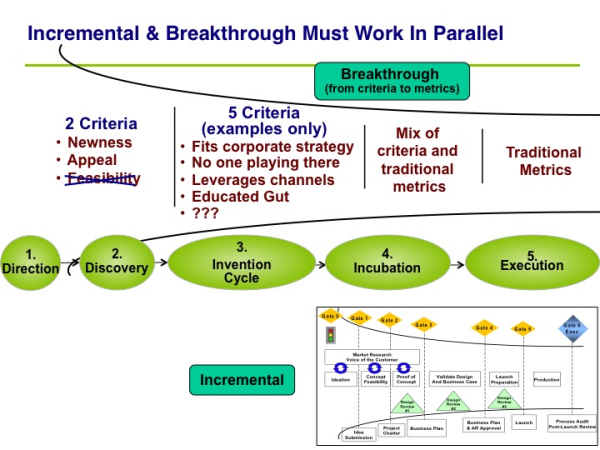
The other day I was having a conversation with the Division President of a large company about innovation. I mentioned to him that in our 30 years in the innovation space, we have noticed that innovation initiatives tend to have a 3-5 year life. The pursuit of breakthrough innovation – “Big Bet” innovation that expands the opportunity for significant growth through expanding markets or creating new ones, takes time. The unfortunate result of changes in Corporate Will is that too often, just when investments begin to pay off with new platforms, new technologies, etc., the efforts are often abandoned.
Read More
Topics:
Innovative Culture,
Communication,
executive sponsor,
Alignment,
Success Factors,
breakthrough innovation,
leadership,
strategy,
Strategic Goals,
decision-making,
breakthrough,
Transformational Innovation,
changing the game,
innovation decision-making
Like it or not, we are in an era of discontent, and it’s only getting worse.
Read More
Topics:
Social Innovation,
social unrest,
peaceful solutions
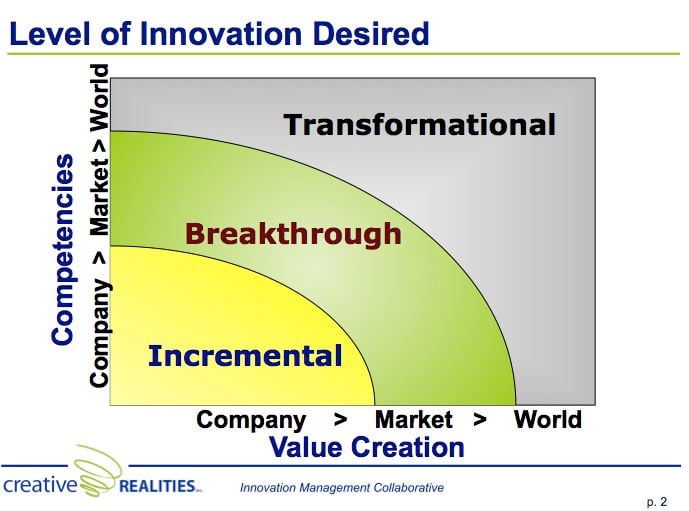
There are three ascending tiers of innovation that you can pursue. The level you choose will dictate the simplicity or complexity of the journey you will undertake. Unfortunately, far too many companies expect to achieve the highest levels of innovation while only providing the strategy, tools, and support for lower-level success, at best. The three levels are:
Read More
Topics:
breakthrough innovation,
Incremental Innovation,
Transformational Innovation,
innovation portfolio
“You’ve got to be very careful if you don’t know where you are going, because you might not get there.”
Read More
Topics:
Future,
Future Pull,
strategic innovation,
strategy,
Strategic Goals,
Vision
When you think of innovative cultures, think of an ice cube:
Change happens at the edges where the ice cube, or the organization, meets the world around it.
Read More
We are often asked if the best way to structure for innovation is top-down or bottom-up? The answer is both if you are going to succeed in the long run.
Read More
Topics:
Mark Sebell,
Stage Gate,
structuring for innovation,
game-changing,
Innovation,
breakthrough innovation,
strategy,
growth,
decision-making,
Incremental Innovation
The over-arching truth about big innovation is this; “You Get What You
PlayFor,” because the processes and tools for managing core businesses don’t work when the goal is to identify and successfully introduce ideas that don’t exist today; true innovations not incremental ones. So you get what you play for and it’s who gets to play that makes all the difference.
When executives create teams to pursue breakthrough innovation they typically push the work down to the operating levels, just like they do so successfully with their core businesses. That sounds eminently laudable – after all, they’re “empowering” a group of hands-on people. They think they are too busy to deal with innovation but there’s another reason for taking that approach: Leaders don’t want to get involved in big innovation. They are afraid of it because they haven’t experienced it or been schooled in managing it; and bosses don’t like being visibly vulnerable.
Topics:
Mark Sebell,
Absurdity,
executive sponsor,
new ideas,
Skin in the game,
Innovation,
breakthrough innovation,
decision-making

 Call Us: 508.359.6048